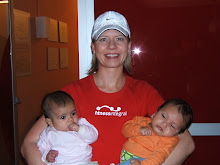
Got a great new question on the perinatal fitness community I run. This one comes from Australia.
She wanted some more specifics on weight training during pregnancy.
Here are my thoughts in no particular order:
-All preggers SHOULD lift weights throughout pregnancy (obviously I mean healthy, non-complicated pregnancies)
-Really, all the "rules" for non-preggers apply such as technique, breathing, core engagement and are just the same (don't hold your breath, focus on good technique, etc.)
-Weight training is a great way to avoid gestational diabetes (I would argue a better way than cardio if I had to pick between the two)
-If you have been lifting regularly before getting pregnant, there is no need to stop. As the trimesters go along you will naturally lower the intensity (good idea). But don't be another one of those women who lifts the little itty bitty pink dumbbells for a million reps! Long sets with no resistance wastes your time. Lift something challenging but that leaves you with a few more reps in the bank. You should finish your sets slightly uncomfortable.
-If you haven't been lifting before getting pregnant, definitely get started! Obviously, just like a non-pregger, progress and get some professional advice on technique and appropriate exercises. The old advice that you can't start new physical activities during pregnancy is crap.
-Heavy squats, deadlifts, etc. do put a lot of pressure on the pelvic floor and can make hemorrhoids worse. Depending on your situation, this may be an area to make changes during pregnancy workouts.
-Work the whole body, including legs, back, chest, buns, core, and arms.
-I don't advocate crunches during pregnancy (or after). Other core work is more appropriate.
-Focus on the back and the posterior chain to help posture and avoid pain
-Learn to control your scapulae to avoid new mom neck and shoulder pain
-Focus on standing exercises (use free weights and cables). Obviously don't lay on your belly after it gets uncomfortable (generally after the first trimester but for some women sooner, especially if it's not the first baby)
-Laying flat on your back gets uncomfortable too as your belly grows so limit to a few minutes or avoid. It's no longer an absolute ban like it used to be as all women are different. If you are one of the ladies who gets uncomfy or dizzy, avoid exercises on your back. Seated or inclined is another option.
-Yes you can lift things over head (contrary to old wives tale), just watch that you can maintain a neutral curve in the lumbar spine.
-Training uses up calories so make sure you eat before and after. Also drink water before, during, and after.
That's all I can think of for now! Remember, pregnancy is not a disease and pregnant women are not ill.
Post your questions and comments below!
Showing posts with label Fitness Integral. Show all posts
Showing posts with label Fitness Integral. Show all posts
Wednesday, June 17, 2009

Saturday, April 25, 2009
Invitation
I would like to invite you to a brand new perinatal fitness community! It's a great supportive site to share experiences while learning about health and fitness during pregnancy and postpartum.
I started this community because I was getting lots of questions on facebook or by email and I thought I could be more helpful putting all the info in one place and by making an interactive site. I hope you like it!
Come and join us at http://www.perinatalfitness.ning.com
I will be uploading content each week so keep checking back for new stuff!
I started this community because I was getting lots of questions on facebook or by email and I thought I could be more helpful putting all the info in one place and by making an interactive site. I hope you like it!
Come and join us at http://www.perinatalfitness.ning.com
I will be uploading content each week so keep checking back for new stuff!
Friday, April 17, 2009
The 40-day postpartum quarentine is 40 days too long
Many women are still told not to exercise for 40 days (or 6 weeks) after birth. This well intended advice from medical professionals is unfortunately causing lots of problems for postpartum women such as incontinence, sexual dysfunction, back problems, “jelly bellies”, and poor body image.
The general consensus from gynaecologists and midwives is for women to adhere to a 40 day waiting period after giving birth before starting to exercise. These 40 days are meant to wait for lochia (postpartum bleeding) to stop, stitches to heal, and the uterus to shrink down to its normal size.
While the intention is good, this “rule” causes problems. How can all women, younger, older, first time moms, 10th time moms, with C-sections, with episiotomies, with water births, women who were fit before birth, women who have never exercised, professional athletes, fit into the same 40-day quarantine category?
Also, when told not to exercise, women are left to define exercise themselves. Does this include walking? What about Kegels? And once the 40 days are over, are women allowed to now start running and going to aerobics? Does the body magically recover in 40 days while avoiding exercise?
Women post partum are vulnerable physically and emotionally. It is a time when life is upside down and thinking of her own body becomes a last priority while learning to be a mom and taking care of the little one(s) 24-7. For some, the 40-day rule provides a nice “excuse” to not have to start doing something about the alien postpartum body she has been left with for 6 weeks. While it is great for a new mom to focus on being a mom, this long wait makes recovery MUCH longer and MUCH harder. The longer the wait, the harder it is to get the pelvic floor musculature to respond again. And in many cases, physical therapy machinery is needed to get the process started well. Being a great mom is a lot easier with a properly functioning body.
The other problem with this general guideline is that some women wait the required 40 days and then jump into their normal pre-pregnancy exercises (aerobics, weight training, tennis, etc.) without ever doing the necessary work to reactivate and strengthen the core. This can cause a slew of problems including incontinence, a protruding abdominal wall, and muscular compensations that can lead to back pain, knee pain, etc.
The solution is to give more specific advice. So, instead of this general advice, here are some more specific guidelines for exercise after birth:
1.) Start doing Kegels as soon as able. Ideally this means moments after birth and definitely before leaving the hospital. This actually speeds up perineal healing.
2.) As soon as you can, start walking around and doing some basic mobility exercises. For a normal non-medicated birth this could be within hours. For a medicated birth you may need a little more time to get moving due to the anaesthesia.
3.) Even with lochia, gentle exercises for core recovery can be started within those early days.
4.) Diaphragmatic suction exercises should wait until the uterus has shrunk. This varies from woman to woman. You can try them a month after birth and should definitely be able to do them after the 40 days.
5.) From here the progress should be constant towards brisk walks and core stability.
6.) The 40-day rule is probably a decent guide to follow before starting heavy lifting or other exercises with impact. And even then, a better gauge is for women to have first recovered the core before adding external loading or impact.
7.) The most often skipped step in this recovery series is RESISTANCE TRAINING. The best way to recover a pre-pregnancy slim body, is resistance training accompanied by a clean diet with adequate calories to support breastfeeding. As soon as the pelvic floor can hold its own again and the core is stronger, adding a few days of full body circuits can really speed up the recovery process and best of all, prevent achy backs and necks from all the forward bending that comes with taking care of a baby.
The old-fashioned 40-day guideline is too vague, very conservative, and in most cases harmful. Yes, women should ease back into exercise and should progress through pelvic floor recovery, abdominal reconditioning, and then general conditioning but they definitely should not spend the first 40 days after birth waiting to start exercising. Since after the birth of a mom, life can be quite complicated, it is good to remember that exercising and bonding with the baby are not mutually exclusive. Most postnatal recovery exercises can be done with baby!
The general consensus from gynaecologists and midwives is for women to adhere to a 40 day waiting period after giving birth before starting to exercise. These 40 days are meant to wait for lochia (postpartum bleeding) to stop, stitches to heal, and the uterus to shrink down to its normal size.
While the intention is good, this “rule” causes problems. How can all women, younger, older, first time moms, 10th time moms, with C-sections, with episiotomies, with water births, women who were fit before birth, women who have never exercised, professional athletes, fit into the same 40-day quarantine category?
Also, when told not to exercise, women are left to define exercise themselves. Does this include walking? What about Kegels? And once the 40 days are over, are women allowed to now start running and going to aerobics? Does the body magically recover in 40 days while avoiding exercise?
Women post partum are vulnerable physically and emotionally. It is a time when life is upside down and thinking of her own body becomes a last priority while learning to be a mom and taking care of the little one(s) 24-7. For some, the 40-day rule provides a nice “excuse” to not have to start doing something about the alien postpartum body she has been left with for 6 weeks. While it is great for a new mom to focus on being a mom, this long wait makes recovery MUCH longer and MUCH harder. The longer the wait, the harder it is to get the pelvic floor musculature to respond again. And in many cases, physical therapy machinery is needed to get the process started well. Being a great mom is a lot easier with a properly functioning body.
The other problem with this general guideline is that some women wait the required 40 days and then jump into their normal pre-pregnancy exercises (aerobics, weight training, tennis, etc.) without ever doing the necessary work to reactivate and strengthen the core. This can cause a slew of problems including incontinence, a protruding abdominal wall, and muscular compensations that can lead to back pain, knee pain, etc.
The solution is to give more specific advice. So, instead of this general advice, here are some more specific guidelines for exercise after birth:
1.) Start doing Kegels as soon as able. Ideally this means moments after birth and definitely before leaving the hospital. This actually speeds up perineal healing.
2.) As soon as you can, start walking around and doing some basic mobility exercises. For a normal non-medicated birth this could be within hours. For a medicated birth you may need a little more time to get moving due to the anaesthesia.
3.) Even with lochia, gentle exercises for core recovery can be started within those early days.
4.) Diaphragmatic suction exercises should wait until the uterus has shrunk. This varies from woman to woman. You can try them a month after birth and should definitely be able to do them after the 40 days.
5.) From here the progress should be constant towards brisk walks and core stability.
6.) The 40-day rule is probably a decent guide to follow before starting heavy lifting or other exercises with impact. And even then, a better gauge is for women to have first recovered the core before adding external loading or impact.
7.) The most often skipped step in this recovery series is RESISTANCE TRAINING. The best way to recover a pre-pregnancy slim body, is resistance training accompanied by a clean diet with adequate calories to support breastfeeding. As soon as the pelvic floor can hold its own again and the core is stronger, adding a few days of full body circuits can really speed up the recovery process and best of all, prevent achy backs and necks from all the forward bending that comes with taking care of a baby.
The old-fashioned 40-day guideline is too vague, very conservative, and in most cases harmful. Yes, women should ease back into exercise and should progress through pelvic floor recovery, abdominal reconditioning, and then general conditioning but they definitely should not spend the first 40 days after birth waiting to start exercising. Since after the birth of a mom, life can be quite complicated, it is good to remember that exercising and bonding with the baby are not mutually exclusive. Most postnatal recovery exercises can be done with baby!
Wednesday, April 15, 2009
5 Ways to Jazzercise Your Privates!

The pelvic floor (pf) musculature is really complex and intricate. Fortunately, it is very simple to work because all these muscles have two basic functions that we can consciously control: closing/opening sphincters or lifting up the floor of the pelvic girdle. This is good news because working this delicate area is very simple but can also get boring with only a few options for our daily exercises.
So, here are 5 ways to do Kegels to spice it up for you:
1.) Hold steady
This is the basic Kegel you probably already know. Just squeeze, lift, and hold! Release and repeat. Simple yet effective. These you can get good at doing while multitasking such as driving, working on the computer, talking on the phone, brushing your teeth, etc. Change up the hold time for variety from 3 seconds all the way up to 30 seconds or more.
Warning! Don’t do while driving unless you are good at multitasking. My mother-in-law tried this while driving and almost had an accident. Multitask with other more benign activities until you reach mastery.
2.) Quick fire
To get the most out of our pfs, we need to work them at different speeds. This drill entails contracting and releasing as fast as you can for 10 seconds, resting, and repeating.
3.) Rhythm Squeeze
Pump your perineum with Michael, Britney, Usher, or Elvis! This one is my favourites and gives us endless options by inviting different artists to join us. Just as it says: squeeze and lift with the beat of the music. When you get more advanced, you can trade off between the slow beat and the double beat of the music.
4.) Elevator
These last two require a bit more concentration and fine motor control. In the elevator exercise we can imagine the pf as an apartment building with 3 or 4 floors and activate the musculature in phases. For example, totally relaxed is the basement, 20% contraction is the first floor, 50% is the second floor, 70% is the third floor, and the fourth floor is maximum contraction. Remember that elevator rides can be just up, just down, or you can be a kid on the elevator and joy ride up and down and between floors.
5.) Back to front, front to back
This last exercise is quite tricky and takes some time to master. Here you need to distinguish between the anal, vaginal, and clitoral/urethral parts of the pf muscles. In general, the difficulty increases back to front. The exercise consists of starting the contraction at the anal sphincter and moving to the vagina and then the urethra/clitoris and as usual, releasing and repeating. The harder version is the same but starting at the front and moving to the back.
There you have it. 5 different ways to Jazzercize our private parts!
Sunday, March 15, 2009
Top 2 mistakes in post partum recovery
Top 2 mistakes in postpartum recovery:
1.) Waiting too long to get started
2.) Choosing inappropriate exercises
Waiting too long to get started
Stimulus to the traumatized perineum immediate after birth helps re-establish neuromuscular control much better than waiting weeks or months to get started. Waiting too long to address the recovery of the abdominal wall that stretches immensely, and in many women separates at the midline, can be impossible if waiting longer than 6 months to get started.
The good news is that postnatal recovery programs are designed with a new mom in mind. Many of the exercises can be done while breastfeeding or in just a minute or two while the baby is a sleep.
The most common misconception about abdominal recovery is that traditional crunches will help create a thinner waist and a smaller belly. This is very incorrect!
Postpartum women should avoid traditional abdominal work and be very careful of the exercises they choose. Many typical abdominal exercises (including Pilates) will worsen separated abdominals and can make the belly bigger.
Pelvic floor should be strengthened, the deep abdominal muscles re-toned, and the compensations left over from pregnancy should be corrected first before adding any load to the body. Corrective exercises and “diaphragmatic suction exercises” are the best methods for postpartum recovery.
A new mom needs time to recover. Her body has gone though an incredible journey of pregnancy and birth, and continues to have special needs for lactation and recovery. The hormonal soup within a postpartum mom’s body doesn’t stop with birth and joint laxity can last for months postpartum.
The very best method to aid postpartum recovery is thinking ahead and creating a fabulous connection to your pelvic floor and abdominal muscles before and during pregnancy.
Women who invest the time in prenatal fitness recover much faster postpartum as the neuromuscular connection is stronger, the muscles are more elastic and responsive, and the habit of exercise is more ingrained thus making it easier to get started again after giving birth to your precious child.
Subscribe to:
Posts (Atom)